Pompeii · Archaeological site
Pompeii: a whole Roman city, and bigger than it looks
Pompeii was a Roman city buried by Vesuvius in AD 79 under four to six metres of ash and pumice. Today you walk it on foot, in the open and with very little shade, across about 65 hectares of streets, houses, baths and public buildings. The key is to understand its size before you go in and decide what to see; the best of the finds are in the National Archaeological Museum of Naples.
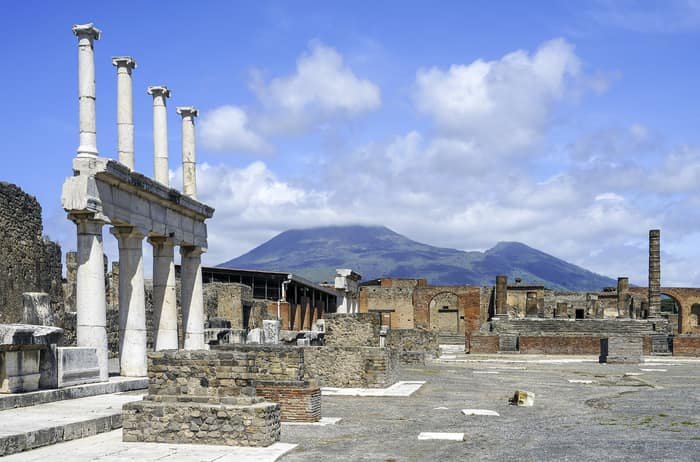
Before you go in: the real size of what you will walk
The city covered between 64 and 67 hectares and had an estimated population of about 11,000, based on household counts. It was built on a lava plateau around 40 metres above sea level; today the sea is about 700 metres away. You walk all of it: streets paved with large stones, stepping stones to cross the roadway and a lot of sun.
The visit works better with a short plan than with a complete circuit. Draw a route through two or three areas and leave the rest for another day; it is more realistic than trying to see everything.
An old town before it was Roman
The first stable settlements date to the 8th century BC, the work of the Oscans, who founded five villages that later merged into a single walled settlement. Greeks, Etruscans and Samnites passed through before Rome took over. That is why the layout is not uniform: the old town, in regions VII and VIII of the excavations, has irregular streets, while later extensions follow a more orderly plan.
Among the oldest remains are the Doric temple, in what became the Triangular Forum, and the Temple of Apollo. They are not the most photographed spots, but they show that Pompeii was not born Roman, or in a day.
What to see if you have three hours
The classics help you find your bearings: the Forum with its temples, the baths, the amphitheatre and the Via dell'Abbondanza, one of the main streets with shops and counters. Add one or two houses with preserved decoration and the plaster casts of the victims, made by filling the gaps that bodies left as they decayed in the ash. Check which houses are open on your day: they open on rotation.
In the House of the Faun you will see a copy of the Alexander Mosaic, not the original; that is in Naples. The graffiti on the walls give good examples of the Latin spoken in the street, much less formal than the language of the classical writers.
A site that keeps changing
Excavations began in 1748. By about 1960 most of the city had been uncovered but left to decay, so new work was limited to specific areas; since 2018 there have been finds in unexplored parts. That is why what is open varies: do not set your heart on one house from an old guide, or on a photo from social media, without checking whether you can go in. Pompeii is a UNESCO World Heritage Site, and conservation explains some closures and marked paths.
If your day is short, Herculaneum, also buried by the eruption, is a smaller site you can cover in less time. It does not replace Pompeii, but it works as an alternative when the heat or the schedule gets tight.
The other half of Pompeii is in Naples
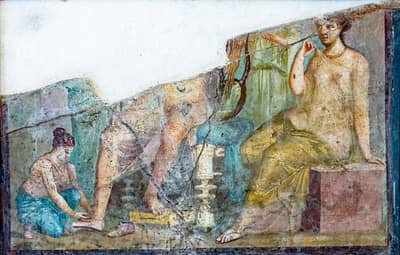
The best-preserved finds, such as the best-known frescoes and mosaics, passed to the museum in Naples during the 18th and 19th centuries. If you are spending two days, the Naples and Pompeii itinerary helps you split museum and ruins. From Naples you can also combine it with other nearby trips, but no more than one a day.
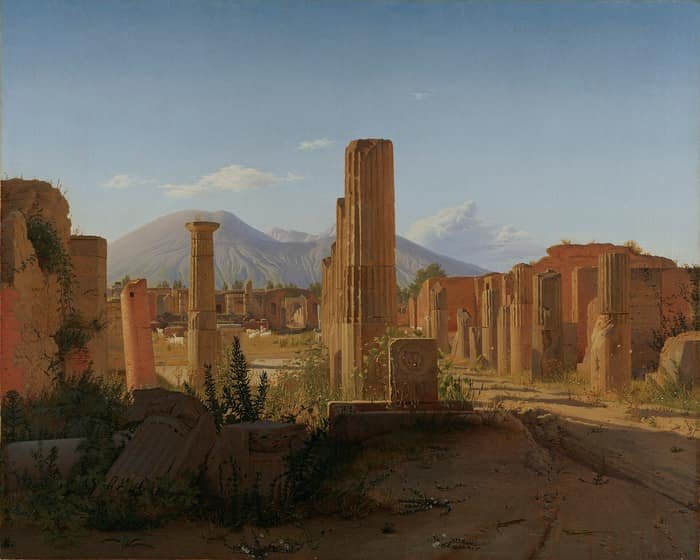
Tips before you go
- Firm-soled shoes. Streets are uneven stone and the sun bounces off them. Thin sandals tire you quickly.
- Water and a hat. There is little shade and distances are long. Bring water and protection, in spring and autumn too.
- Book before you go. Tickets are booked through Weekend in Italy, where you can see prices and availability. That way you arrive with the ticket sorted and nothing to decide in the sun.
- Choose your gate. There are several entrances. If you arrive by train, the one nearest the station is convenient; if you leave by another, plan the return.
- Decide your route first. Pick two or three areas and accept you will not see everything. A day without a plan gets lost among similar streets.
- Travel light. Security at the gate tends to go faster with little luggage. Carry only what you need.
- Consider a guide or audioguide. Without explanation, many houses look like empty rooms with painted walls. With it, they make sense.
- See the museum another time. Do not try to fit ruins and museum into one day unless you start very early. Each is better on its own.
Frequently asked questions
How long do I need for Pompeii?
Three to four hours for a full visit. With two hours, only a selection of the main areas.
How do I get from Naples to Pompeii?
The usual way is the Circumvesuviana train to Pompei Scavi, which drops you next to one of the gates. Check times for the day of your visit.
Is there much shade?
No. It is an open-air site with little shade; bring water, a cap and comfortable shoes.
Where are the best-known frescoes and mosaics?
A good share are in the National Archaeological Museum of Naples, not in Pompeii. It is better to see both.
Can I visit with children?
Yes, though the ground is uneven and there is little shade. Go early and carry water.
Affiliate link: if you book, this site may receive a commission.